Capture
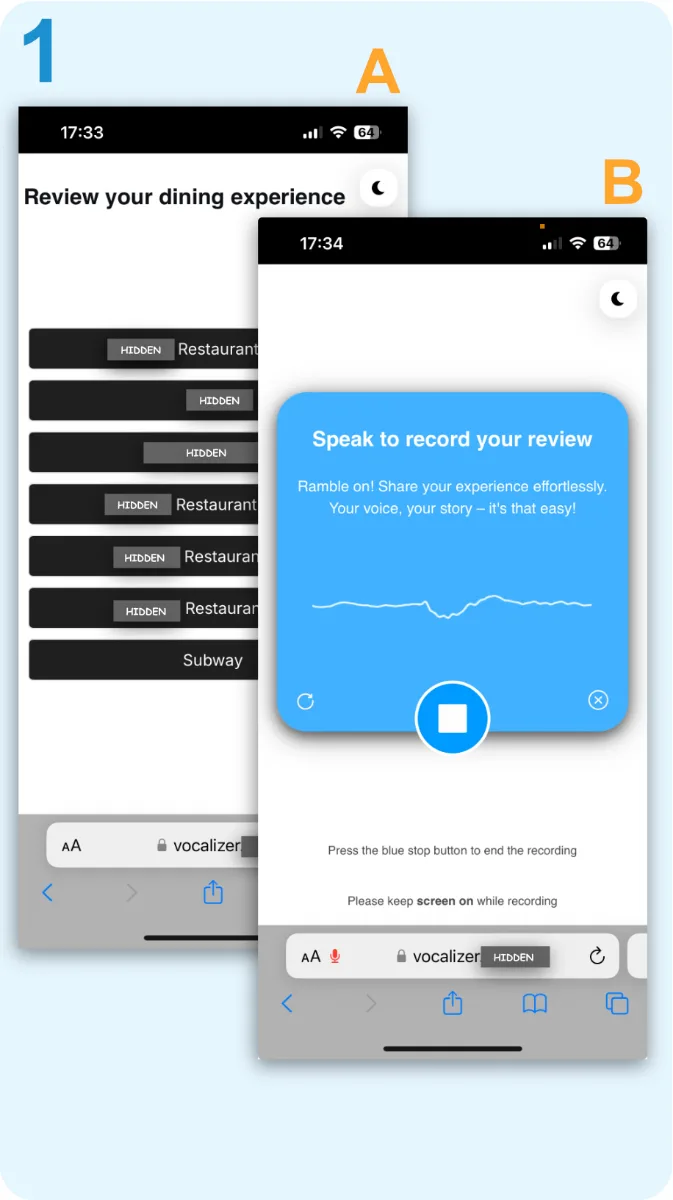
A mobile web app: pick the restaurant, speak, watch the waveform move. Up to five minutes of recording, transcribed by Whisper.
 ← All projects
ACM MUM 2024, first author
You talk about your lunch. The app turns what you said into a review you would actually post, and keeps rewriting it until you say it is right.
01 The problem
Almost everyone has an opinion about lunch. Hardly anyone types it into a review form on a phone, standing up, after the moment has passed.
So the brief was narrow on purpose. Let people ramble, clean up only what speech gets wrong, and leave every change after that to them. The model edits. It does not write the review for you.
02 Cleaning up speech
Uh yeah so I went to the restaurant and I had the um I don’t remember the name a hamburger with the wedges it was very good but maybe a bit too salty in the chips but yeah it was good.
I visited the restaurant recently and tried their hamburger with wedges. The meal was quite enjoyable, although the chips were a tad too salty for my taste. Overall, it was a good dining experience.
Same meal, same verdict, same complaint about the salt. The cleanup runs at temperature 0.2, the least inventive setting in the app, and is told to keep the content and the tone.
03 One review, start to finish
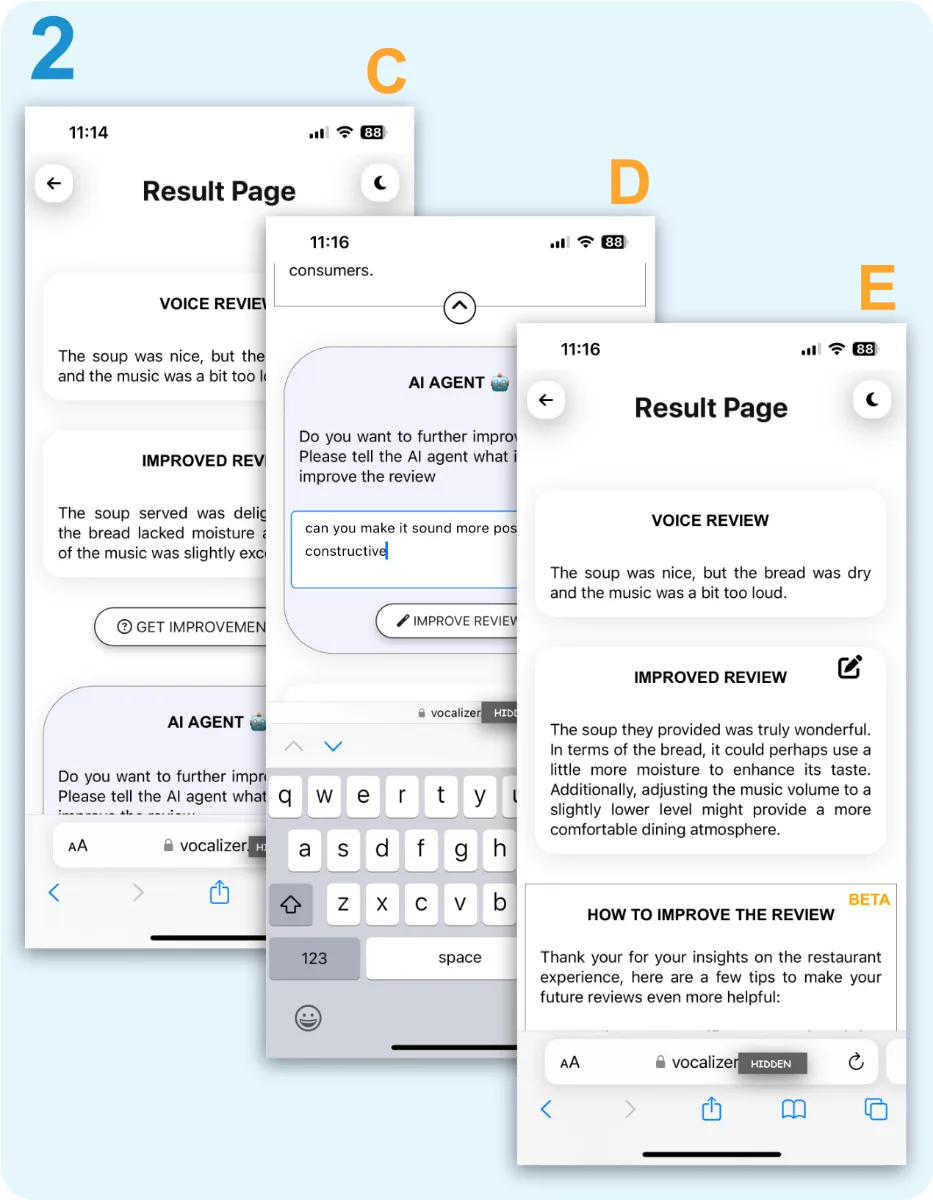
“The soup was nice, but the bread was dry and the music was a bit too loud.”
Both versions
Pick the restaurant and talk. A waveform moves while you do. The countdown only shows after 30 seconds, so nobody feels rushed, and there is room for five minutes.
Both versions
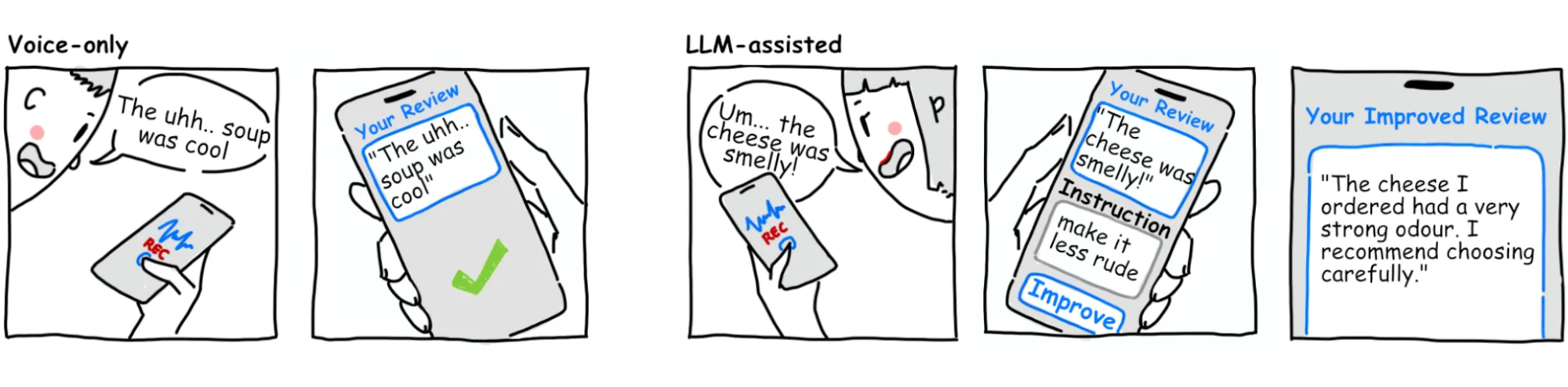
OpenAI Whisper turns the recording into text straight away. In the voice-only version this is where it ends: fix it by hand, or submit.
Assisted version
GPT-4 removes the ums, fixes the grammar and drops anything off topic, keeping the content and the tone. The original transcript stays on screen next to it.
Assisted version
Type what should change and the agent rewrites the review. Repeat until it is right, or start again from the recording.
“can you make it sound more positive and constructive”
Assisted version
One tap for advice built on research into what makes a review useful: specific, detailed and easy to read.
“the soup was very tasty”
→ which soup, and what made it good?
Both versions
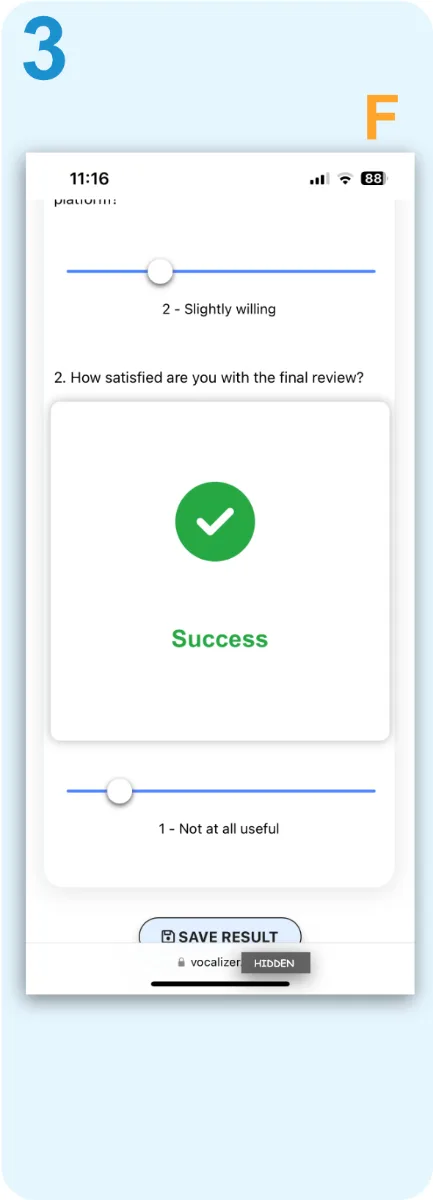
Quick sliders before sending: how willing you would be to share it, how happy you are with it, and whether the agent helped.
04 The app
05 The study
Group A 8 people
Group B 6 people
Real meals at campus restaurants, at least five reviews with each version, a short questionnaire after each and one at the end. The two groups started with different versions, so neither version got the advantage of going second.
06 What changed
“How certain are you that you can leave a good review?” Out of 10.
4.53 → 5.93 out of 7, voice only against assisted. Significant, p < 0.05.
With the final review, out of 7, over 82 reviews.
Every improvement tip that was asked for.
User experience scored higher for the assisted version on every dimension, 6.17 against 5.52, but none of those differences was statistically significant. And the unaided confidence score was asked at the end of the study, not the start, which the paper names as a limitation.
07 What people asked for
The most common request was for more, not less: people wanted their own review to say more of what they had noticed. The more reviews someone had written before, the longer their instructions were (Spearman 0.94).
08 In their words
“You can just explain the experience out loud as you would to a friend, and then you can just fix it up with the AI features. Genius.”
Every participant preferred the assisted version.
“It is easier to leave a review as you can say the review in an unstructured way and the AI makes it structured.”P11
“When I use this app, it motivates me to do a review. I don’t need to think about grammar mistakes, and the AI-given review is very good.”P14
“people with broken English can create well written reviews”P6
“if AI corrects a lot of the sentences, that will hide the people’s honest feelings”P12
“it suppresses our critical thinking ability.”P4
“people find it too easy to write restaurant reviews that they would say malicious things without thinking, making it easier to defame restaurants without a justified cause.”P9
09 What I built
The same project was my master’s thesis at the University of Oulu. The paper is the study written up for a wider audience.
A mobile web app: pick the restaurant, speak, watch the waveform move. Up to five minutes of recording, transcribed by Whisper.
GPT-4 at a low temperature, told to keep the content and the tone and to remove only the fillers, the grammar slips and whatever went off topic.
Three separate model steps, each with its own prompt and temperature: the cleanup at 0.2, the agent at 0.8, and research-based tips at 1.
Fourteen people, two versions of the app, 157 reviews. Willingness to share the review went up 31% with the assistant, and confidence in writing a good one went up 88%. The write-up became my first-author paper at ACM MUM 2024. Read it (opens in a new tab)
Cited as an example of voice AI agent development, and of how voice changes the way people interact with interfaces.
Referenced for higher response rates and better review quality in automated notification systems.
10 The paper
From Voice to Value: Leveraging AI to Enhance Spoken Online Reviews on the Go
Read the paper ↗ (opens in a new tab)